The need for speed to hit an optimum planting window between rains is part of a trend toward larger planters with central fill systems, and larger tractors to pull them. However, the time savings can come at a cost to plant health and yield if the planting pass adds to soil compaction.
Soil compacted at planting can inhibit moisture and nutrient movement and stunt plant root growth, making it difficult for the plant to make its way out of the furrow. That’s why it’s important to minimize compaction at planting. It may not be as evident in good years, but it’s an extremely wet or an extremely dry growing season that those stresses really take their toll on the growing crop. Plant scientists at Purdue University, the University of Nebraska and elsewhere report that areas of soybean fields with moderate to severe soil compaction are associated with increased levels of sudden death syndrome.
Whatever the conditions present at planting, experts recommend paying attention to two important factors that growers can have control over: using the right tire pressure for the job, and the choice of tire type used on tractors, planters and other field equipment. With new developments in tire technology and innovations like VarioGrip, the tire pressure system on Fendt tractors, along with new weight-management systems on planters, using tire pressure to manage equipment weight and soil compaction can be easier and more effective than before.
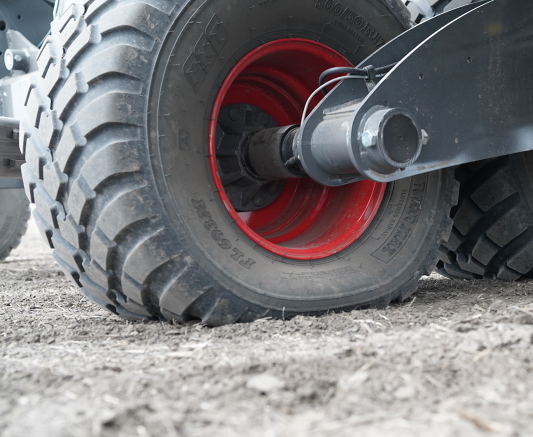
Tires are the contact point between the machine and the ground. So as machines get bigger, they get more efficient and effective, but also heavier, so they also can create more damage through soil compaction. The rule of thumb is that whatever pressure is in the tire, the resulting pressure exerted on the ground is 10% to 20% more than that. Excess ground-contact pressure from the tires is what causes compaction.
When possible, use the minimal allowed tire-inflation pressure to carry the known axle load. That gives the biggest footprint, spreads that weight over a larger area, and minimizes the compaction in the soil.
So, it’s important to weigh the axle loads of tractors and equipment such as planters to know the total load configuration. That load, combined with the tire size and the predicted speed of the operation, determine the recommended pressure based on tire inflation tables and/or online calculators from the manufacturer.